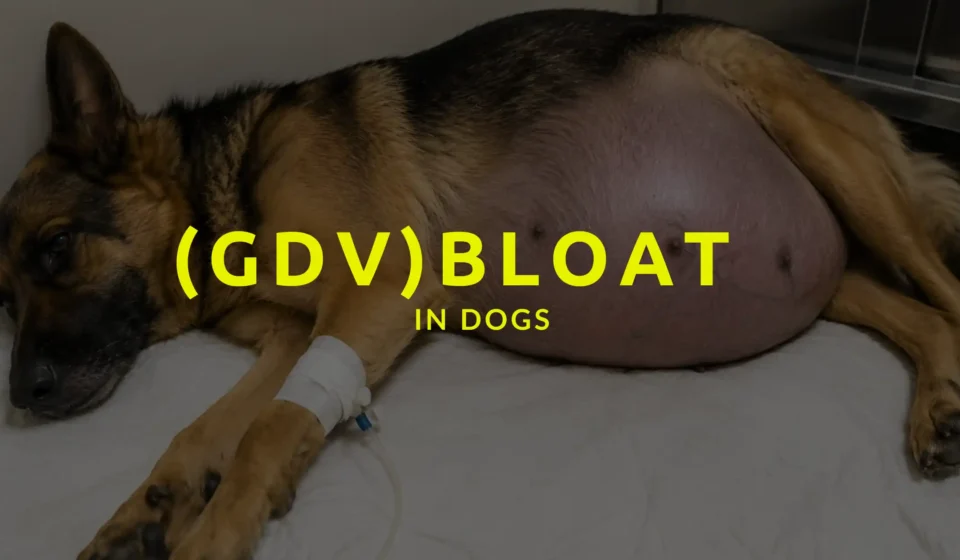

A few years back I got a call from my friend at midnight. Her dog had eaten dinner like normal and played with its toys. Then within an hour, he was pacing the living room, drooling, and trying to throw up nothing. They immediately took her to the vet.
By the time they got to the emergency vet, his stomach had already flipped. He survived because they didn’t wait until morning. That’s the thing about bloat in dogs it doesn’t give you much time to decide what to do.
Bloat, or GDV (gastric dilatation and volvulus), is one of the few conditions in dogs where minutes actually matter more than hours. It’s not something you monitor overnight and call the vet about tomorrow. It needs prompt action.
This guide walks through what canine GDV actually is. The early warning signs, and why acting fast is the only thing that changes the outcome.
Table of Contents
What Is GDV in Dogs?
GDV happens in two stages. Once you understand the two stages, you’ll see why catching the early signs matters so much.
Gastric dilatation: It is the first stage where the stomach fills with gas, food, or fluid and swells up like a balloon. This alone is dangerous, but it’s the second stage that turns it into an emergency.
Volvulus: This is when the swollen stomach actually flips or rotates on itself. As it twists, it cuts off its own blood supply. The blood can’t flow in or out. The tissue starts to die, and the dog can go into shock within a couple of hours. This is why the condition is called gastric dilatation and volvulus, or gastric dilatation volvulus (GDV). The dilatation is the warning sign and the volvulus is the actual emergency.
Some owners describe it as their dog’s “stomach flipping”. Once the twist happens, surgery is the only way to fix it, and every hour of delay lowers the odds of a good outcome.
Which Dogs Are Most at Risk
GDV isn’t random. A few factors show up again and again:
- Large, deep-chested breeds: Great Danes, German Shepherds, Standard Poodles, Weimaraners, Boxers, and Setters top the list
- Older dogs: Risk climbs with age, especially past 7
- Eating fast or gulping large amounts of food in one sitting
- One large meal a day instead of split feedings
- Exercising right after eating
- Family history: If a parent had it, the risk is higher
If your dog fits more than one of these risk factors, learn the signs now. You might not have much time to look them up later.
8 Signs of Bloat and Stomach Twisting in Dogs
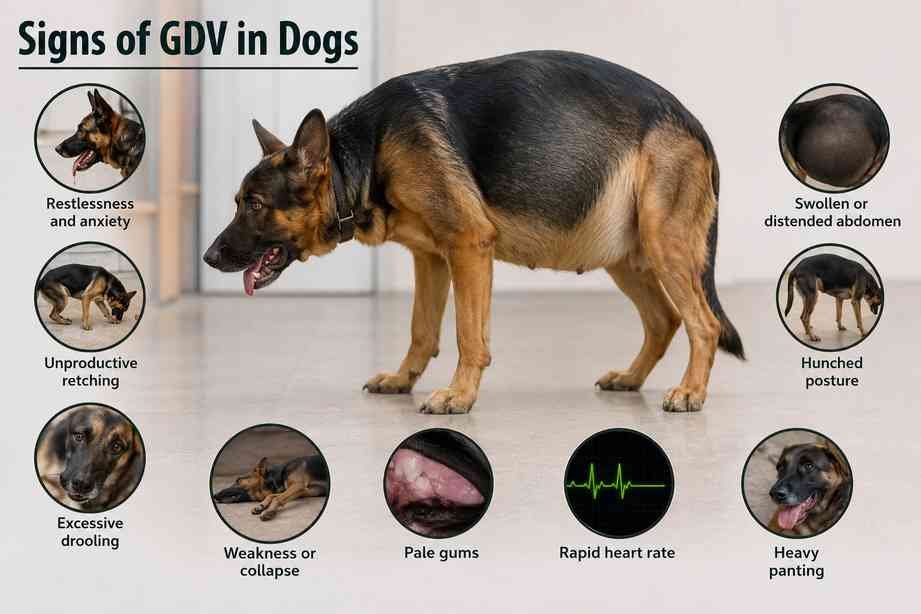
Here’s what to watch for. Not every dog shows every sign. These signs and symptoms can escalate within 30–60 minutes.
1. A visibly swollen or distended stomach: This is usually the first thing owners notice. The belly looks tight, round, and larger than normal, sometimes described as looking like the dog swallowed a basketball. Gently tap the stomach as a bloated stomach can sound hollow, like a drum.
2. Retching or trying to vomit without bringing anything up: This is one of the clearest red flags of gastric dilatation volvulus. The dog heaves repeatedly. Sometimes they can bring up foam or nothing at all. It is because the twisted stomach is blocked and simply can’t empty.
(If your dog’s appetite has been off in general rather than this being a sudden episode, that’s a different issue — see our guide on why your dog isn’t eating.)
3. Restlessness and pacing: Dogs suddenly can’t settle. They keep getting up and lying back down, or paces in circles. This shows that they are often in real pain, even before other signs are obvious.
4. Excessive drooling: Heavy and sudden drooling more than a dog’s normal amount is also a common early symptom that gets overlooked because it doesn’t look as alarming as it is.
5. A hunched or “praying” posture: Dogs in pain often stretch their front legs out with their rear end raised, or hunch their back. They keep trying different positions to relieve the pressure in their belly.
6. Rapid breathing or a fast heart rate: As the stomach swells, it presses on the diaphragm and major blood vessels. Breathing becomes shallow and quick. The heart rate climbs as the body starts going into shock.
7. Weakness, collapse, or pale gums: This is a late-stage sign that the dog is in shock. Pale or white gums, wobbliness, or collapse mean you need emergency care immediately. This isn’t a “watch and wait” symptom.
8. A sudden change in behavior after eating: If a dog goes from normal to visibly distressed within an hour or two of a large meal especially combined with any of the signs above, treat it as an emergency until proven otherwise.
What to Do If You See These Signs
There is no home remedy for GDV. No amount of walking it off, waiting it out, or watching for it to “pass” will help. Every hour that passes without surgery lowers survival odds significantly. If your dog shows two or more of these signs.
Especially a swollen belly along with retching that brings nothing up, get to an emergency vet right away. Call ahead if you can so they’re ready when you arrive.
Diagnosis is typically confirmed with an X-ray, and treatment for confirmed volvulus is surgery. Untwisting the stomach and, in most cases, a procedure called gastropexy that tacks the stomach to the abdominal wall to prevent it from twisting again.
Can GDV Be Prevented?
There’s no guaranteed way to prevent bloat, but a few habits meaningfully lower the risk, especially in high-risk breeds:
- Feed two or three smaller meals a day instead of one large one
- Use a slow-feeder bowl if your dog gulps food
- Avoid vigorous exercise for at least an hour before and after meals
- Talk to your vet about a preventive gastropexy if you have a high-risk breed. Some owners choose to do this during a spay or neuter surgery
Some owners choose to do this during a spay or neuter surgery (if your dog is recovering from spaying, see our guide on what to feed a dog after spaying for recovery diet tips)
Final Thoughts
Bloat is frightening because it can look mild at first a little restless, a bit of drooling and become life-threatening within an hour. If you own a large or deep-chested breed, it’s worth talking to your vet now about your dog’s specific risk and what a preventive gastropexy would involve. It is better than learning the signs for the first time in an emergency room waiting area.
If you ever find yourself unsure whether what you’re seeing is bloated then treat it as bloat. A trip to the emergency vet that turns out to be nothing costs you a bill and an evening. Waiting when it really is GDV can cost your dog’s life as Cornell’s veterinary team notes, without treatment, GDV is fatal.

Comments are closed.
[…] I wrote about the warning signs of GDV, a lot of readers asked me the same question and that’s why bloat for dogs happen in the […]
[…] large swollen/bloated stomach needs immediate vet attention. A visible swollen belly is a classic sign of GDV in dogs. The stomach expands like a balloon. Bloat, or GDV (gastric dilatation and volvulus), is one of the […]