
GDV (gastric dilatation and volvulus) in dogs is a serious condition. The dilatation is the stage where your dogs stomach swells. And volvulus is when the swollen belly flips cutting the blood supply.
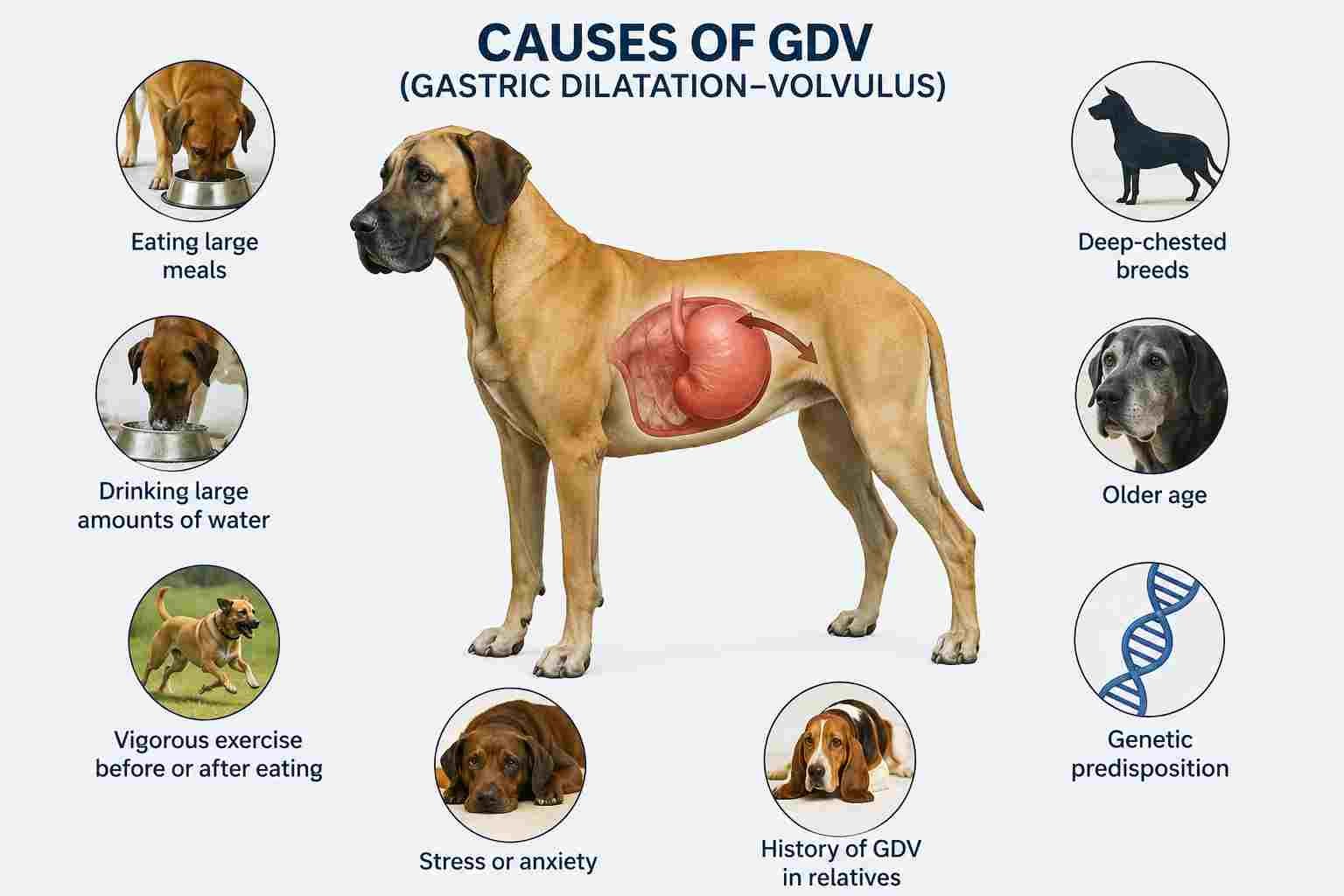
It is caused by a combination of factors commonly a deep, narrow chest shape, eating too fast, one large meal a day, exercising right after eating, older age, family history, and stress. There is no one thing by itself that causes GDV. The risk increases when several of these factors happen together.
After I wrote about the warning signs of GDV, a lot of readers asked me the same question and that’s why bloat for dogs happen in the first place? The honest answer is that GDV rarely comes down to one single mistake. It usually occurs when several factors stack up.
Understanding what actually causes a bloat stomach dog condition, or a full-blown twisted stomach in dogs, won’t guarantee it never happens. But you can make it less likely especially if your dog’s breed is already prone to it. Here’s what actually drives gastric dilatation and volvulus (GDV) in dogs.
Table of Contents
What Is GDV, Physically? (So the Causes Make Sense)
Before getting into causes, it is important to know what “bloat” really means. The stomach fills with gas, food, or fluid and stretches out (balloon like shape) this is dog gastric dilation. It’s usually the first visible sign of a dog’s stomach.
In some dogs, that swollen stomach then rotates on itself. A gastric volvulus dog owners often describe as their dog’s stomach flipping and cutting off blood flow to the stomach. The causes below are the things that make that swelling and the twist more likely to happen.
8 Causes and Risk Factors for GDV in Dogs
| Cause | Why It Raises Risk |
|---|---|
| Deep, narrow chest | More room for the stomach to swing and rotate |
| Eating too fast | Swallowed air adds to gas buildup |
| One large meal a day | A fully stretched stomach shifts more easily |
| Exercise near mealtime | Movement on a full stomach makes twisting easier |
| Older age | Ligaments holding the stomach loosen over time |
| Family history | Inherited risk, independent of breed alone |
| Stress and anxiety | Anxious dogs eat faster and swallow more air |
| Raised food bowls | May increase air swallowed while eating |
1. Deep, narrow chest conformation: This is the single biggest factor. Breeds with a deep chest and narrow waist like Great Danes, Weimaraners, Standard Poodles, German Shepherds, Doberman Pinschers, and Saint Bernards have more room for the stomach to swing and rotate. A wider, shallower chest simply doesn’t give the stomach the same space to flip.
2. Eating too fast: Dogs that gulp their food fast swallow a lot of air along with it. That extra air adds to gas buildup in the stomach. This is one of the most direct triggers of gastric dilatation.
3. One large meal a day instead of smaller portions: When the stomach is completely full and stretched out, it has more room and weight to move around inside the belly. Dogs who are fed a single large meal have a higher risk than dogs fed two or three smaller meals spread throughout the day.
4. Exercise right before or after eating: Intense activities on a full stomach like running, jumping, or playing fetch makes it easier for the stomach to twist. This is why most vets recommend waiting at least an hour on either side of a meal before letting a dog exercise hard.
5. Age: Risk climbs steadily as dogs get older, particularly past age 7. The exact reason isn’t fully understood. One theory is that the tissue holding a dog’s stomach in place gets a little looser with age that looseness makes it easier for the stomach to twist.
6. Family history: If a dog’s parent has had GDV then the dog carries a higher risk. Breeders and vets increasingly treat family history as a real factor when assessing a dog’s individual risk, not just breed alone.
7. Stress and anxiety: Some researchers and vet also states that stress may raise the risk of GDV. Vets often see it linked to boarding, travel, a new environment, or a tense household. Anxious dogs also tend to eat faster and gulp more air, which adds to the risk on top of the stress itself.
8. Raised food bowls (a debated one): Raised food bowls were recommended for deep chested dogs. More recent research has actually contradicted it. Some studies suggest elevated bowls may increase GDV risk rather than reduce it.
It is because dogs swallow more air eating from a raised angle. If you own a high-risk breed, it’s worth asking your vet directly rather than assuming the old advice still holds.
Is There One Direct Cause of GDV?
No single cause guarantees a dog will develop GDV. And no single precaution guarantees it won’t occur. It’s a combination of a dog’s body shape, feeding habits, activity around mealtimes, age, and genetics. That’s exactly why the early warning signs a swollen belly, unproductive retching, restlessness matters so much.
How to Lower the Risk of GDV
Based on the causes above, a few habits make a real difference for high-risk dogs:
- Feed two or three smaller meals instead of one large one
- Use a slow-feeder bowl if your dog eats fast
- Skip raised food bowls unless your vet specifically recommends one for your dog
- Avoid hard exercise for at least an hour before and after meals
- Ask your vet about a preventive gastropexy if your dog is a high-risk breed. This is sometimes done alongside a spay or neuter, and you can read more about recovery diets after spaying if your dog has one scheduled.
- Keep mealtimes calm and low-stress, especially for anxious dogs
FAQs About GDV Causes in Dogs
- What is the main cause of GDV in dogs? There isn’t a single main cause. It’s usually a combination of a deep, narrow chest shape, eating too fast, and factors like age or a large single meal. Breed and body shape are the biggest underlying risk factor for canine GDV.
- Can small dogs get GDV? It’s rare, but not impossible. Gastric dilatation volvulus is heavily concentrated in large, deep-chested breeds, but occasional cases of gastric volvulus are reported in smaller dogs. Especially if they have a deep chest relative to their size.
- Does dry kibble cause bloat? Kibble itself isn’t a proven direct cause. Some studies have looked at kibble that expands with moisture or contains citric acid as a possible contributing factor. Fast eating and gulping air matter more than the food type itself when it comes to dog GDV symptoms showing up after a meal.
- Is GDV genetic? Genetics plays a real role. Dogs with a parent or littermate that had gastric dilatation volvulus carry a higher risk. Certain breeds are predisposed due to their inherited body shape.
- Can stress alone cause GDV? Stress alone probably isn’t enough to cause it, but it’s considered a contributing factor. Especially since anxious dogs often eat faster and swallow more air, which does directly raise the risk of gastric dilatation and volvulus in dogs.
- Does age make GDV more likely? Yes. Risk increases steadily as dogs get older, particularly past age 7. It is because the ligaments that hold the stomach in place loosen somewhat over time, making a twisted stomach more likely.
Final Thoughts
If your dog fits several of these risk factors, it’s worth having a direct conversation with your vet about prevention. GDV is one of those conditions where the causes are well understood, but prevention is still about stacking the odds in your dog’s favor, not guaranteeing an outcome. Waiting when it really is GDV can cost your dog’s life as Cornell’s veterinary team notes, without treatment, GDV is fatal.

Comments are closed.
[…] A large swollen/bloated stomach needs immediate vet attention. A visible swollen belly is a classic sign of GDV in dogs. The stomach expands like a balloon. Bloat, or GDV (gastric dilatation and volvulus), is one of the few conditions in dogs where minutes actually matter more than hours. To learn more about it do check our GDV in dogs blog. […]