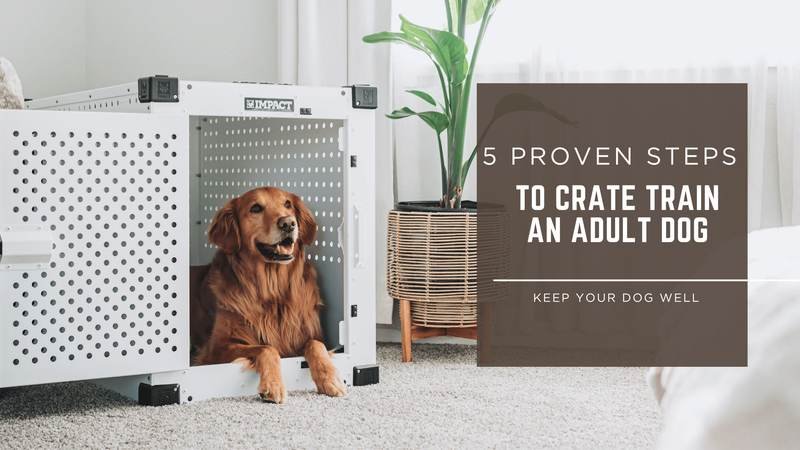

I always talk about my dog Jessy in most of my blogs, even though I have had multiple dogs. It is because she is the first dog to grow up with me. When she was a puppy, I would hold her close and let her sleep with me.
We never crate-trained her as a puppy. When she turned 3, we decided to crate-train her. Everyone said it’s hard to crate-train an adult dog. They are comfortable with how they already live and too stubborn to learn something new. I agree that adjusting to a new behaviour or routine can be difficult for them, but it’s not impossible. Jessy proved that to us within a few weeks.
If you are looking to crate-train an adult dog for the first time, choose the right size crate. Many owners make mistakes by purchasing a hung crate. It’s the mistake I almost made with Jessy too.
Table of Contents
Choose the right crate size
Many owners believe that the larger the crate, the better it is for the dogs. They think more space equals more comfort. A dog’s sleeping area is supposed to be clean. But with a larger crate, dogs can use one end to sleep and the other end to do their bathroom.
Once this habit is formed, it’s hard to undo it. To properly crate train an adult dog, we must find the right size crate.
To determine whether the crate is the right size, your dog should be able to stand up fully, turn around without bumping the sides, and lie down completely stretched out. When we were looking for a crate, I was second-guessing myself. I wanted to buy a larger crate thinking it would be more comfortable for her.
If your dog is still growing, most crates come with a divider panel so you can buy the adult size now and block off the extra space until they grow into it.
Can you really crate train an adult dog?
Yes, you can crate train an adult dog. To be honest, you can crate train a dog of any age. Age is not an obstacle, but people assume it themselves.
Adult dogs have a longer attention span than puppies. The real obstacle is the dog’s history. We have had Jessy since she was a puppy. So, she doesn’t have past trauma or anxiety with the crate. But some dogs, unfortunately, come with anxiety or trauma with confinement because of a bad experience.
If you introduce the crate correctly as a safe, comfortable space rather than punishment, it will be easier for your dog to adjust to it.
Why crate train an adult dog?
Before we get into how we actually did it with Jessy. It’s worth being honest about why you’d put an adult dog through this. Here are some reasons why to crate train an adult dog:
- Safety when you’re not home: A crated dog can’t chew on a door frame, go through the trash, or swallow something dangerous
- A calmer vet visit or boarding stay: A dog who’s relaxed in a crate handles unfamiliar environments with far less stress
- A space that’s actually theirs: Dogs also need personal space just like us. Once she was trained, Jessy started walking into her crate on her own to nap, completely unprompted, which is when I knew it had worked
- Faster house training: Especially useful if you’ve adopted an adult dog and don’t know their bathroom habits yet
How to Crate Train an Adult Dog: Our Step-by-Step Process
This is the exact process we used with Jessy. You can also adjust it slightly depending on how your dog reacts at each stage. Go slower than you think you need to. This was our biggest lesson.
Step 1: Let Them Investigate on Their Own Terms
We put the crate in the living room with the door open and didn’t push Jessy toward it at all. I tossed a few treats near the door. Then a few inside the crate and let her go inside automatically without any force. She sniffed around it for almost two full days before she ever stepped a paw inside. This is completely normal for an adult dog. They’re more cautious than a puppy would be.
Step 2: Feed Meals Near, Then Inside, the Crate
Once she was comfortable sniffing around it, I started placing her food bowl closer to the crate each day. I would place her food bowl even closer each time. This is the step that changed her attitude toward the crate fastest. It’s because food does a lot of the persuading for you.
Step 3: Practice Short, Door-Open Sessions
With the door still open, we let her wander in and out freely. We used her favorite treat to encourage her and rewarded her for settling even for a few seconds. We did several short sessions a day instead of one long one. Adult dogs settle into new routines through repetition and not duration. It was suggested by our vet.
Step 4: Close the Door for Seconds, Not Minutes
The first time I closed the door on Jessy, I sat right next to the crate and counted to ten before opening it again. She was definitely shouting, but my presence kept her cool. It felt almost silly at the time, but rushing this step is exactly where most adult dogs start whining or scratching. Once that starts, you have to start from the very beginning. So have patience and go slower.
Step 5: Build Up to Longer Periods and Independence
From there, we stretched the time gradually for a few minutes, then long enough for me to leave the room, then long enough for me to leave the house for a short while. One thing I learned the hard way is to keep your goodbyes and hellos boring. The first few times I came home and made a big fuss over her, she started getting more worked up before I left. A calm entrance teaches a calm exit.
How to Crate Train an Adult Dog With Separation Anxiety
This part of Jessy’s story actually overlapped with her crate training. She dealt with real separation anxiety, which I’ve gone into more detail on in my separation anxiety post. It changes the process, and it deserves its own approach rather than being lumped in with a normal timeline.
- Practice “mini-departures”: Grab your keys, walk to the door, come right back, before ever leaving for real
- Leave a piece of your unwashed clothing in the crate so it smells like you
- Skip the long, emotional goodbyes: They tell your dog something worth worrying about is happening
- If the anxiety doesn’t ease with consistent practice, involve your vet or a certified trainer. Some dogs need more support than crate training alone can give them
How to Crate Train an Adult Dog at Night
Nighttime crating was actually smoother for us than daytime crating. Since Jessy already had an established bedtime routine. We kept her crate in our bedroom at night. We would always keep her crate in our bedroom at night, and during the day we would shift it to the living room.
A last bathroom break and a consistent “goodnight” cue did most of the work here.
Frequently Asked Questions
Q1. Is it too late to crate train an adult dog?
Ans. No, there is no age to crate train an adult dog. We crate-trained Jessy at 3 years old with no prior crate exposure at all. And it worked. Dogs of any age can be crate trained; it just takes more patience and shorter sessions than puppy training does.
Q2. Does a bigger crate work better for training an adult dog for the first time?
Ans. No, a bigger crate is one of the most common first-time mistakes. Dogs instinctively keep their sleeping area clean, so too much extra space lets them sleep at one end and use the other as a bathroom. The crate should only be big enough to stand, turn around, and lie down in.
Q3. How long should an adult dog stay in a crate?
Ans. Healthy adult dogs can generally handle up to four to six hours, with regular breaks for water, movement, and bathroom time. A crate is a training tool, not a full-time living space. So, keep them familiar with the crate. We would let our dogs stay in the crate at night, when there is no one in the house or when guests arrive.
Q4. Will my dog resent (to feel angry, bitter, or upset) me for crate training them?
Ans. No, when it’s introduced gradually and paired with positive experiences, most dogs come to see the crate as their own safe space. They don’t view it as a punishment. Jessy walks into hers on her own to nap.
Q5. What if my adult dog cries every time I close the crate door?
Ans. Go back a step. Shorten the time the door stays closed, sit closer for longer, and rebuild their confidence before extending the duration again. Crying is feedback that you moved too fast, not a sign of failure.
This lines up with guidance from the American Veterinary Society of Animal Behavior, which recommends reward-based, gradual methods over forced confinement for anxious dogs.
If you’re crate training a dog with separation anxiety specifically, our guide on Separation Anxiety in Dogs: 5 Heartbreaking Signs to Watch covers the signs worth watching for alongside this process.